Hysteria Ward – All The Madmen Records – 1986 – Private recordings – 1981 / 1982

September 8th, 2012

REPOSTED FROM NOVEMBER 2007 DUE TO SOME RARE CASSETTE TAPES BEING LENT TO ME RECENTLY BY LOUISE AS WELL AS AN INFORMAL ‘INTERVIEW’ UNDERTAKEN.

Brett, Lou and Tony D Puppy Mansions 1981 – photo – Tony D collection

Louise Harris once of the Kill Your Pet Puppy collective, veteran of Campbell Buildings, St Monicas and other slum squats alongside Bob Short and Lisa of Blood And Roses, Quick Phil, Cory, Tony D, The Heretics and Dave Sex Gang amongst many others. A Wapping autonomy centre and Centro Iberico regular.

One of the most pleasant women around and a massive help to a much younger Penguin when I first started helping out at All The Madmen records in Brougham Road Hackney.

The Hysteria Ward cassette is a rare All The Madmen release indeed. Not many cassettes around any more I would think. I have added some rough mixes of some of the tracks that featured on the original cassette. These rough mixes are very good indeed. The rough mixes were recently lent to me by Lou herself and simply must be heard… I have been also been reminded by Dan I that All The Madmen records also released a flexi disc by Hysteria Ward. I forgot all about that release; but of course I own it. I have added it to this post now!

SOME HISTORY

Lou was living with the Puppy Collective at Puppy Mansions in Westbere Road Hampstead during 1981. Lou along with other house mates went to witness a gig in the squatted ‘Grimaldi’ church in Pentonville Road, Kings Cross.  The Grimaldi church was so called as that is the resting place for a famous clown Joseph Grimaldi who died in 1837. The proper name for the church to any other congregation, other than punk squatters, was St James.

Amongst the bands performing that night was The Mob. This was the first time Lou had witnessed the band and she was shortly in a relationship with Mark from the band. Through Mark who was living at 74 Brougham Road at the time, Lou met Josef Porta and Tim Hutton amongst other notable Brougham Road co – op members. Tim at the time was drumming for The Mob. Josef was drumming for Zounds.

When Lou was commuting from Puppy Mansions into Hackney to see Mark Mob in Brougham Road it was decided one night to record a low key jam in Josef’s bedroom at 64 Brougham Road.  One of the tracks on this personal tape is entitled ‘Shalom’ which means peace in Hebrew. This is a track that was written by Lou after she was badly attacked by two skinhead girls in Kilburn. Brett and Mick Lugworm from Puppy Mansions managed to get Lou to the Royal Free hospital in Hampstead to get cleaned up and mended.

Josef drums, Tim guitar and Lou on second guitar and vocals.

Lou with Tim Hutton and Josef Porta 1981 <<< Tape to download>>>

This line up ventured out of Josef’s bedroom only twice Lou remembers. Once at a pub now forgotten when an amp blew up so no performance was completed, and once on the Fuck Off stage set up at Stonehenge. The Stonehenge performance went ahead but as Lou and Tim had dropped acid a little while before, it was not that memorable at least to Lou who was tripping heavily. She remembers the reception to the performance was pretty good but that could be just the drugs! The band retreated back to the KYPP tent after the performance to enjoy the rest of the evening at the stones on Salisbury plain.

Lou (with the blue denim jacket on) at a Mob gig in Belgium - photo – Onno Hesselink collection

Tim Hutton who drummed briefly for The Mob before Josef Porta’s stint on the drum stool at a gig in Belgium. Tim a Brougham Road resident also performed bass duties for Zounds in a short lived four piece band – photo – Onno Hesselink collection

Lou was at Brougham Road waiting to travel with The Mob on one of the Belgium and Holland tours. At the same time that the police were raiding 64 Brougham Road to hassle the assorted Zounds personnel that were barricaded within, Lou and The Mob were loading the truck to drive to Harwich to get the ferry. Last man in shuts the door. The door shuts and then falls off into the street. Trying not to be so obvious whilst a police presence is within pissing distance, the members of The Mob hastily attach the door back on and make a quick getaway with whatever stash they were going to Europe with. Mark who was driving to Harwich was not in the best of spirits. Not because his near neighbours were getting busted, or because of the state of the truck. The problem was that all the other passengers in the vehicle were swallowing magic mushrooms while Mark was the designated driver…

Peat Protest, Mitch Flack, Martin Flack and Andy Martin of The Apostles at the Wapping Autonomy Centre - photo – Martin Flack collection

Andy Martin from The Apostles was also a huge motivator for Lou. Lou ended up at the top room of the squat that Andy had in Foulden Road, Stoke Newington, and between them composed and performed several tracks that appear on the tape that you may download below. Lou got on with Andy Martin very well and even got a cake given to her, made from Andy for her to share with Mark from The Mob. Commuting to Stoke Newington was also pivotal to Lou’s future as it was there that she was first introduced to Rob Challice then of Faction. Lou had seen Rob at the Wapping autonomy centre but had not up to this point ever spoken to him. Lou sold Rob her heavy black bass guitar in fact in Andy’s Foulden Road squat!

Lou with mostly Andy Martin 1981 <<< Tape to download>>>

In 1981 Lou had also been a member of The Witches who infamously performed with The Apostles, Blood And Roses and Part 1 at the Wapping autonomy centre in January 1982. This event was the first time Part 1 had successfully performed in the capital. The Witches also had in the band’s ranks Ann Gee Zoff who at this time was Bob Short’s partner in Hackney squatdom.

Lou was still living at Puppy Mansions in Westbere Road Hampstead. Through the house she met up with Paul AKA Jah Pork Pie again. Paul was another survivor of Campbell Buildings alongside Tony D.

Spasm Ensemble was a band that included Lou on vocals, Mick Lugworm on guitar and Jah Pork Pie on bass. This band performed in the North Cheam and Esher areas of south west London but according to Lou, was just a band that would get together if another band advertised on any flyers did not turn up!

Mental Disorder was another band that Lou was involved in with Mick Lugworm around this time. The band used to rehearse in a pub in Esher (Surrey). This was useful as the band were offered free refreshments throughout the practice sessions.  There was another band that used to be involved with this pub that was run by the parents of two brothers who were in a band called Wargasm (before the compilation of the same name was released). Neither were in Mental Disorder but at least one of them did play with Spasm Ensemble. Part Time Pousurz was another Lou and Mick Lugworm band that did have Fred Previous within the bands ranks.

Jah Pork Pie was involved in another band with Lou, Dream. Also featured in the band was Lou’s brother Max Harris on keyboards. The band was influenced by Patti Smith (Lou’s greatest influence then and now) and Pink Military.

Lou at Centro Iberico 1982 – photo – Mick Lugworm collection

Dream performed at the Harrow Road autonomy centre, the Centro Iberico on a couple of occasions in the summer of 1982.

Dream – Centro Iberico June 1982 <<< Tape to download>>>

Dream – Private Recordings 1982 <<< Tape to download>>>

Both sides of this cassette are recorded in mono and the cassette ‘sleeve’ is an old page of KYPP fanzine issue five; cassette info hand written by Mick Lugworm!

But around the middle of 1982 Lou had a life changing moment and the darkness started to cast around her already fragile psyche.

Lou’s parents decided to organise their daughter to be sectioned under the mental health act in the autumn of 1982. Lou was self-harming at an alarmingly consistent rate at this stage. Lou’s father unbeknown to Lou at the time picked her up in his car and drove her to Tooting Springfield hospital and dropped her off there to be ‘examined’.

The area in the hospital that Lou was taken to was the Wisteria Ward.

She spent around eight weeks on the ward. During this time she was being forced fed antipsychotic drugs which were not working, just gave her several episodes of jerking fits. Procyclidine, an anticholinergic drug was added to the daily menu.

She had friends visiting during this time one of which Mark Edmonson the guitarist of Youth In Asia.

Mark made a deal with the hospital and with Lou’s parents to look after Lou and that he would ensure she took her drugs. Mark allowed Lou to stay at Lithos Road in Finchley. Soon enough the two were in a relationship. Mark got Lou into Youth In Asia as a second guitarist. They played several gigs toward the end of 1982 the pinnacle of which was performing at the Black Sheep housing co – op organised Zig Zag squat all day gig in Westbourne Park late on in December. Crass also helped to advertise and clean this venue for the day’s events. The first choice of squatted venue, the Rainbow in Finsbury Park, was found to be too risky the night before. Youth In Asia performed amongst the cream of 1982 anarcho punk bands including Flux Of Pink Indians, Poison Girls, The Mob, Faction, The Apostles, Amebix, Omega Tribe, Null And Void and Crass.

Lou left Youth In Asia early on in 1983 as Mike Clarke from the band Windsor’s Disease took over guitar duties. Mike was a far more accomplished guitarist than Lou at that time. Probably still is. Kay from the band continued to inspire Lou to get back to being a vocalist in a band.

Lou was still living with Mark in Lithos Road and as Mark was very close to Crass, the couple would spend many days away from London and in the beautiful confines of Dial House in North Weald Essex. Lou wrote in a long distressed letter about her feelings about the street violence she saw around her and the experiences that she had with being assulted. Penny wrote a very long and kindly reply to Lou which she states helped her immensely. It was around this time that Lou and Penny Rimbaud from Crass discussed a possible single release on the Crass record label. Lou went into a studio to record some demos for Penny. Involved in the session was Simon who was the partner of Lou’s sister. Two tracks recorded were ‘Grey man’ a track written about her experiences in Wisteria Ward at the Totting Springfield hospital and ‘The Field’ about the Stonehenge trips that Lou had embarked on with the Puppy Collective and the Brougham Road crew. After these tracks were complete the cassette tape was given to Penny who unfortunately but politely rejected the material.

Youth In Asia were also offered a release on Crass but alas split up shortly before it was organised. Members of Youth In Asia turned up shortly afterwards as Decadent Few.

Lithos Road in Finchley was suddenly becoming populated with punks and squatters due to a new Autonomy Centre starting off opposite Mark’s co-op squat. This autonomy centre was named the Burn It Down Ballroom. This venue / workspace was where the bands on the scene would turn up to to perform; hand in hand with the Rosebery Avenue autonomy centre in Islington which was up and running around the same time.

Mark moved out of Lithos Road in 1984 and the space was taken up by a good friend of the Puppy Collective; Julian AKA Joe Pop.

Rob Challice was still a Brougham Road resident living at number 96 where he was in charge of Wot Distribution and All The Madmen records. Andy Morgan soon to join Blyth Power was Rob’s co worker at this time. The office was at the front of the building on the second floor overlooking the many trucks and converted buses that would be parked up along the road with many people and dogs and cats residing on them.  JC and New Zealand Darren were also residing at 96 Brougham Road at this stage.

Joe Pop moved out of Lithos Road towards the end of 1985 and Rob who was now in a relationship with Lou spent the day time hours in Brougham Road and night time hours in Lithos Road with Lou.

Around this time after a gap of around a year Lou felt confident enough to start singing again on stage with a band. She placed an advert in Melody Maker stating Magazine, Bowie and Patti Smith as influences which gained interest from a band (with no vocalist) called Umbrellas Of Cherbourg.

The musicians Boggie, Squid and Mick who eventually formed the backbone of Hysteria Ward were (happily enough) friends of Mark Edmonson from Youth In Asia who had got Lou out of the Wisteria Ward and into his care some years previously.

Lou – photo – Lou’s collection

Rob Challice guided Lou and her band Hysteria Ward into the pubs and clubs of the time towards the end of 1985; one special occasion was when the band performed at a street party in Lithos Road along with Lou’s old band mates Decadent Few. Hysteria Ward were a much more professional and long-standing band than Lou’s previous band incarnations, with the immense help of Rob Challice the band performed many times in London. Lou or myself whilst we were talking trying to remember the ‘history’ could not remember Hysteria Ward performing outside London except for a performance in Brighton in April 1986.

Blyth Power, Hysteria Ward and Wat Tyler all jumped into JC’s bus parked outside 96 Brougham Road along with myself, I had started working for ‘free’ at All The Madmen records from the last months of 1985, Sean Gummidge the Wat Tyler vocalist was within the All The Madmen ranks around six months previous to myself. JC drove us to the seaside together and we all did normal seaside type things throughout the day finishing off with a blistering gig in the evening. Hysteria Ward played well that night probably because Brighton crowds were not quite as cynical as London crowds who tended to resort to heckling quite easily. Robin and Lee from Acid Rain tapes organised this classic gig with all the bands caught on the top of their game at the Art College Basement.

Hysteria Ward – photo – Darren Clements collection

Hysteria Ward seemed to go through several drummers in quite a quick time. Squid also left the band after little after a year. New Zealand Darren who was still living at 96 Brougham Road along with JC joined as the band’s drummer. Rob Challice had left Brougham  Road and was living full time with Lou at Lithos Road.

Rob Challice and Lou during a break in recording at R.M.S. studio – photo – Lou’s collection

Rob Challice had been getting Hysteria Ward some studio time throughout the differing line ups and some of the results ended up on the All The Madmen released cassette tape and flexi disc released at the beginning of 1987.

All The Madmen had left Brougham Road early in 1987 to engage in the hustle and bustle of Caledonian Road in Kings Cross. Above Better Badges, below Fuck Off Tapes (several months later to be replaced by Cooking Vinyl). Over the road to Rough Trade Distribution. A much different experience than the relative laid back vibe of the hidden away from the main drag, Brougham Road in Hackney.

Vendetta / As Was / Free Spirits / Breakfast To Madness / 1000 Years Ago / The Saint <<< Tape to download>>>

Vietnam / Ribbons And Roses / Jungle / Rep-Hes-Dev / The Lodge / Peace Song <<< Tape to download>>>

Rough Mixes 1 <<< Tape to download>>>

Rough Mixes 2 <<< Tape to download>>>

Vendetta/ The Saint  <<< Flexi to download>>>

John Peel played the flexi disc on several occasions. Hysteria Ward continued to perform gigs but things started to sour a little with the slog and the low audience appreciation. Times had changed on the gig circuit. Bands like Napalm Death and Extreme Noise Terror were getting the excitement of the crowd by 1987, not bands like Hysteria Ward.

Timebox night at the Bull And Gate Kentish Town 1986 – photo – Lou’s collection

The last gig Hysteria Ward performed was at the Bull And Gate in Kentish Town in 1987. The band told Lou that they were fed up and wanted to move on to other things. Boggie and Lou, the two original members of the band left after that night’s gig, remained friends and still see each other to this day. As does Squid another original member of Hysteria Ward who left a year before.

Rob and Lou moved out of Lithos Road and into a house in Willesden sometime in 1988.

Rob stopped the All The Madmen record label and started off Firefly records (Vision Of Change) and started to work closely with Michelle Shocked. Rob also started to put on US/ UK hardcore shows at the Sir George Robey in Finsbury Park alongside Rob Tennant of the Vinyl Solution record shop. Sean went on to continue his 69 tapes empire and eventually got his ‘dream’ job at Rough Trade Ladbroke Grove. I went onto begin King Penguin Distribution and eventually got my ‘dream’ job at Southern Studios / Southern Record Distribution early in 1989.

Lou who had already performed several ‘acoustic’ solo gigs, memorably one at Meanwhile Gardens in 1987 continued to perform solo. Rob Challice organised an Italian tour for her in the 1990′s. With the rise of the Mad Pride culture celebrating individuals that society feels are ‘unwell’. Hysteria Ward reformed for the odd gig or two. Old Wapping autonomy Centre regular, Apostles and Rudimentary Peni supporter Robert Dellar, who used to produce the ‘Straight Up’ fanzine from Watford and then Brighton, was heavily involved in getting his old friend Lou back on the stage during this time in the 1990′s. Robert Dellar was also the chap who was involved in Spare Change book publishing, Nick Blinko’s ‘The Primal Screamer’ is on Spare Change books as is ‘Mad Pride’ – the book an essay in ‘Mad Pride’ is written by Louise herself.

Artwork by Lou – Lou’s collection

These days Lou lives quietly with her grown up daughter Rebecca in Barnet. Rob Challice, Rebecca’s father also lives locally to Louise in Barnet.

Thanks to Lou for lending me these personal cassettes and photographs to accompany this post and also for discussing all the memories one Saturday afternoon.

Please forgive Lou if some dates or some facts are blurred. It all happened a long time ago and Lou still has to take similar drugs to the ones given out to her when she was a patient at the Wisperia ward in 1982. Thirty years ago. So some of her memories are blurred and collide somewhat.

Someday All The Adults Will Die – Hayward Gallery Project Space – London SE1

September 6th, 2012

‘SOMEDAY ALL THE ADULTS WILL DIE’

Punk Graphics 1971- 1984

Hayward Gallery Project Space

14 September – 4 November 2012

Admission Free

From 14 September to 4 November 2012, the Hayward Gallery Project Space on the South Bank in London will host ‘Someday All the Adults Will Die’: Punk Graphics 1971 – 1984, a comprehensive overview of punk graphic design from before, during, and after the punk years. Curated by Johan Kugelberg and Jon Savage, the exhibition will include several hundred pieces of previously unseen material from private archives and collections: home made cassettes, fanzines, posters, handbills, records and clothing. Highlights include work by Gee Vaucher, Jamie Reid, Gary Panter, Raymond Pettibon, John Holmstrom and Penny Rimbaud, alongside numerous anonymous artists.

Schedule of Events:

Press View: 11am – 1pm Thursday 13 September

There will be a panel discussion moderated by exhibition co-curator Johan Kugelberg (Thursday 13 September at 7pm, £10). Tickets can be purchased HERE

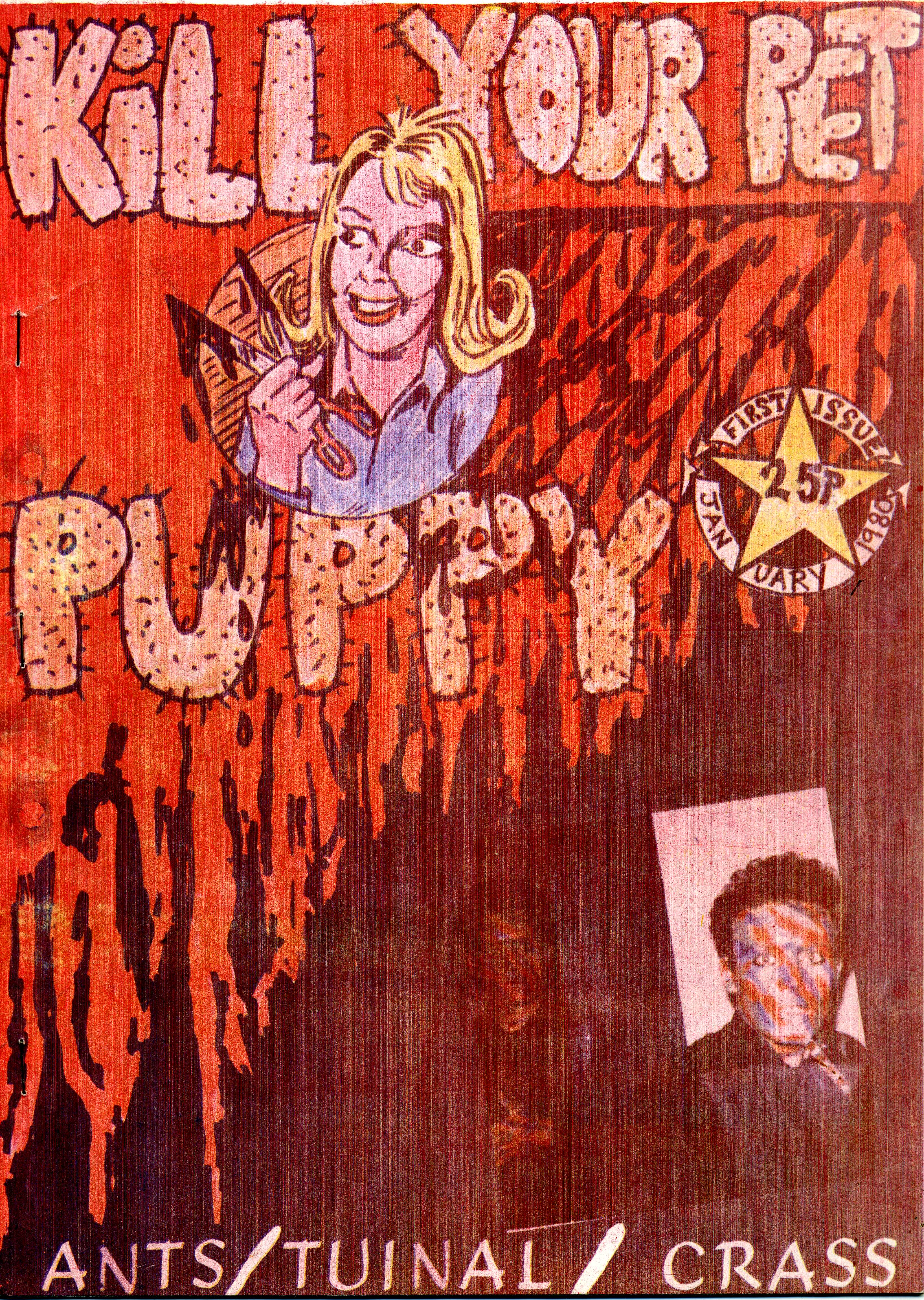
The panel discussion at the Purcell Room, Southbank Centre will explore the provocative graphic art that developed alongside punk rock. Panelists will include Tony Drayton, editor of Ripped & Torn, one of the first UK punk fanzines, and Kill Your Pet Puppy – arguably one of the most aesthetically interesting anarcho-punk fanzines of the ’80s; William Gibson, award winning writer and seminal cyberpunk novelist; John Holmstrom, writer, cartoonist and legendary editor of the iconic Punk magazine; and artist Gee Vaucher, whose record covers and newsletters for anarcho-punk band Crass in the late 1970s and early ’80s influenced graphics for political protest as well as for music.

The exhibition coincides with the publication of  Punk: An Aesthetic by Johan Kugelberg and Jon Savage, published by Rizzoli.

“If you don’t like the culture you are spoon-fed, you can make your own. It worked wonders at the end of the seventies, and all these jagged, chiaroscuro urgent masterpieces of graphic design, executed by art school masters alongside anguished adolescents continue to reverberate as get-up-and-get-on-with-it eyeball-pleasers.” – Johan Kugelberg, co-curator

Spanning a range of different media, works presented in ‘Someday All the Adults Will Die’: Punk Graphics 1971 – 1984 include: various ephemera such as clothing designed by

Vivienne Westwood and Malcolm McLaren; early press releases and pamphlets for the Sex Pistols and the Ramones; publications and early fanzines including London’s Outrage, Punk, Sniffin’ Glue, and Suburban Press; a rare chance to see and hear a collection of DIY 7” records from international punk labels and artists of the period; situationist-informed prints produced at art school by Malcolm McLaren; limited edition Black Flag prints from the early 1980s by Raymond Pettibon; a Linder Sterling flyer for a 1978 Joy Division performance in Manchester; and six banners used to advertise The Great Rock ‘n’ Roll Swindle, a 1980 ‘documentary’ film about the Sex Pistols, designed by Jamie Reid – whose cut-and-paste aesthetic became synonymous with the graphic imagery of the punk movement, particularly in the UK.

Curators:

Johan Kugelberg is the author of The Velvet Underground: New York Art, and also organises exhibitions and runs Boo-Hooray gallery in New York. He is also the founder of the Cornell University hip hop history and punk history archives.

Jon Savage is a journalist and the author of England’s Dreaming: Sex Pistols and Punk Rock and Teenage: The Creation of Youth Culture, among many other books. 

Southbank Centre is the UK’s largest arts centre, occupying a 21-acre site that sits in the midst of London’s most vibrant cultural quarter on the South Bank of the Thames. The site has an extraordinary creative and architectural history stretching back to the 1951 Festival of Britain. Southbank Centre is home to the Royal Festival Hall, Queen Elizabeth Hall, Purcell Room and the Hayward Gallery as well as The Saison Poetry Library and the Arts Council Collection. www.southbankcentre.co.uk.

For more information, contact visit our website HERE

Boo-Hooray is an exhibit space dedicated to 20th/21st century counter-culture ephemera, photography and book arts. We publish catalogues, books, artists’ books and LP’s regularly, as well as arrange readings and performances.

Address:

265 Canal St, 6th Floor, Chinatown NYC

boo-hooray.com

Blood And Roses – Life After Death Cassette – 96 Tapes – tracks remastered by Bob Short

September 4th, 2012

A new post and a KYPP exclusive. Blood And Roses, personally one of my favourite bands from the early 1980′s.

Bob Short is currently working on a new Blood And Roses album with Lisa. Hopefully it’ll come together but it involves passing recordings from Bob to Lisa across continents. Part of the process has been for Bob to remaster the tracks off of the ‘Love After Death’ cassette to work out what was being played and what the lyrics are. Fifty minutes of the original ninety minute cassette has been completed so far. That equates to eighteen tracks out of twenty eight from the original 96 Tapes release. Bob thought he would offer the results to KYPP in case anyone was interested as he has just spent a week or two trying to improve the quality! A kind thought indeed. There might be more tracks to come.

Thanks to Bob Short for sending me the remastered tracks all the way from New South Wales and also for the text written out below. Many thanks also to Andy Martin for the text he wrote on Blood And Roses and sent to me a couple of years ago. I have attached Andy Martin’s text below Bob Short’s.

BLOOD AND ROSES ‘LIFE AFTER DEATH’ REMASTERED (Tracklisting below)

01/ Scenario (Rehearsal  1981)

02/ Louie Louie (Rehearsal  1981)

03/ Paradise (Rehearsal  1981)

04/ I’m Waiting For My Man (Rehearsal  1981)

05/ Jesus (Clarendon Hotel 1981)

06/ Roles (Rehearsal  1981)

07/ Product Of Love (Clarendon Hotel 1981)

08/ Sympathy (Rehearsal  1981)

09/ Mummy (Clarendon Hotel  1981)

10/ Strychnine (Rehearsal  1981)

11/ Your Sin Is Your Salvation (8 Track Demo)

12/ Curse On You (8 Track Demo)

13/ Necromantra (8 Track Demo)

14/ Spit upon Your Grave (16 Track Demo)

15/ Possession (16 Track Demo)

16/ Tomorrow (8 Track Demo)

17/ Your Sin Is Your Salvation (Dub) (Casenove Road Demo)

18/ Love Under Will (8 Track Demo)

Looking back over thirty years, I am confronted by a world that even I find difficult to recognise; a world of cassette tape recorders with condenser microphones and telephone boxes on the corner, listening to John Peel on a battery powered transistor by candlelight. Sure kid, we had electricity in those days – unless you hadn’t quite managed to get it together to steal an old meter and jerry rig it into the squat wall. Or the police had torn it off said wall for kicks. Or the Council had dug up the lines in front of the house in an attempt to save on eviction costs. Or one of your friends had decided the meter was a Dalek during some kind of drug fuelled psychotic episode. Could have been some kind of power cut. They seemed to always be happening because of strikes or cut backs or something. Maybe God just decided to take a dump on. It’s been known to happen. Ask Job.

Was it surprising that there was always some kind of shit happening? There was always some sort of bomb going off here and a riot or two there. Margaret Thatcher was Prime Minister and, like some kind of hell spawned Midas, everything she touched turned to shit. There was still good old British know how and crap made out of Bakelite barely holding the circuits of London together. When the fuse blew up in your plug, you wrapped foil from your cigarette packet around it. Every appliance in the capital seemed to be attached to a frayed cloth lead with odd patches of exposed metal shining through from where one of the local sewer rat went and fried itself. Why there wasn’t some all consuming second great fire is one of life’s great mysteries. Possibly, it was always raining.

Fortunately, if the power was off and the cold wind blew, you could always shuffle your way down to some club in search of light and heat. Of course you had to avoid a long list of youth sub cultures in your travels. Every night in London town was a reinvention of The Odyssey as told by some third rate Cockney Walter Hill. Can you dig it? Why did you go to gigs when skinheads were always turning up to beat you up? Well. If you stayed home they’d come around and beat you up anyway. You might as well go out, hang out with the herd and better your chances. And there was music (or at least some rhythmic pulsing noise pretending it was music.)

There’s the nostalgic cut and thrust part of proceeding dealt with. War Stories for the barely impressionable. Funny to think now that those second World War fogeys we mocked were closer to 1945 than we are to 1977. I just needed to get the idea of time and place settled before I talk about “Life and Death”, a cassette only release by Blood and Roses that was released by 96 Tapes in 1983/4. The reason it came out in the first place was every morning I woke up to a pile of blank cassettes and self addressed stamped envelopes courtesy of the mail man. Various darkly covered envelopes with felt pen decoration would make their introductions. Do you have any demo recordings? Live recordings? And dutifully I’d sit there pressing play and pause and waste precious time I could be indulging in debauchery. In hindsight, I know I was participating in a huge underground network communicating ideas and culture. If you think about it, it is a rather amazing phenomenon that probably deserves a University thesis. The trouble was, I was never a great revolutionary. I may well have had my revolutionary ideas and ideals but I essentially wanted to consume copious amounts of substances both illicit and otherwise whilst having sex with women. There were certain people who considered this to be reprehensible but they generally were not having sex with anyone so I envied them nothing.

“Rob,” I said to the Lord High God of 96 Tapes.  “Just let me shove everything on a cassette and they can buy it off of your fledgling musical empire. Then I can get on with my pitiful attempts at wenching and less than successful attempts at filling the gutters of Hackney with my vomit.”

“Sure,” says the Bossman. “How much do you want to charge?”

“Just costs. I don’t want to make any money off this shit”

“What do you want to put on the cover? We could put bats and spiders’ webs and shit on it. We could do a real Banshee’s thing on it”

“Fuck that. Put something repulsively cute on the cover. A baby seal. Some pretty flowers.”

“I got this picture of the kitten”

“Perfect.” says I. And that was the extent of our business and marketing dealings.

And perhaps that sounds dumb and cynical and somehow lacking in cultural, revolutionary or artistic zeal or merit. But if you want the truth about how this project got off of the ground, there you have it. But before you get too disappointed, just remember art has a funny way of shining through. These were a collection of recordings made in complete seriousness under absolutely absurd constraints. And when I actually went to put the master tape together, I began to realise I was actually creating a very weird piece of work. Instead of looking for the perfect takes – or even the acceptable takes – I was collecting a series of snap shots about how a band essentially comes in to being. And it is strangely compelling in a way that more commercially acceptable anthologies are not. That still didn’t prepare me for the fact that Robin Gibson gave it a five star album review in Sounds. What was he thinking?

Then I’d start reading someone say that this was ”the real Blood and Roses album” and… in many ways they were right.

Blood and Roses played most of their gigs in squats and squatted venues through PA’s that were far from effective. Okay; occasionally they were guitar amps or record player amplifiers and not PA’s at all and that may have explained their abject failures. In an attempt to hear herself, Lisa plugged her microphone into a guitar pedal. Any improvement in levels was at best a placebo.

I had a semi acoustic guitar I had bought for ten pounds (I got to knock the price down from fifteen because it didn’t have any pick-ups). I taped some pick-ups from a smashed guitar into it and then stuffed it full of toilet paper to stop it feeding back. We owned no amps. Whatever we could beg to play through we played too loud because it seemed like that was how you were supposed to do it.

It wasn’t like we were playing venues with sound guys. We just did our best to tack all this crappy equipment together and then put a cassette player somewhere. Then we’d get on the train or the bus home and listen to the cassette happily as our fellow public transport users recoiled in horror. Any venues that heard these tapes would black list us, nail their doors shut and call the police. So, yes. I guess this really is the authentic Blood and Roses album; not born of dreams but nightmares.

But it is not as if I am claiming some unique way of working. This determined seizure and misuse of any or all available tools of production was rampant. This was, however, a separation of working method from the first wave of punk bands who talked the talk about doing it yourself but pretty much recorded the same way all those rock and roll vampires had recorded; talked their way into record company demo’s. By the early Eighties, the major record companies had enough punk bands to keep them going. Gary Bushell’s myopic lenses kept the various sonic experiments committed in the nation’s squats in a state of premeditated commercial suicide. Even Crass seemed to have access to some sort of legitimate form of production. Given how far outside of society we had all tumbled, we clung to the lyrics of those we thought had blazed our trail. Someone locked the door? I’ll kick my way back in. Or that was the plan.

The music industry did not care if Andy Martin lurked in his attic with a couple of tape recorders and a five watt amp churning out  Apostle album after Apostle album having nothing but time on his hands. Out on the edge of the smoke, Faction pressed play and record, thrashed for a minute and a half and then pressed stop. Repeat until you have a dozen songs. Fill in the name of two hundred offenders I fail to mention. A house could fill up with band tapes if you didn’t watch out and remember to tape over them with your own band. Nothing like a roll of sticky tape to foil those copy protect tabs.

That is the world “Life After Death” begins in. The Clapham demo was created via a revolutionary idea. On a less than bright Sunday afternoon, we jumped the tube across the river and set up all of what little gear we could scrounge into the basement of a squat. I had got hold of this 35 watt amp that, if you pushed every dial up to full you could almost hear over the drums. When we played back the half dozen songs we recorded, we couldn’t hear the vocals at all. No problem. We put the cassette into another machine and then had Lisa sing it again with her right next to the recorder. The instrumental “Scenario” got added words because I picked up the first available book and read where I opened it at. Typically the library book in question must have fallen open at the… ahem… most read section. Professional microphone? Nah. The crappy built in thing records sound doesn’t it? High quality cassettes? I picked up these from that stall outside Boots for fifty pence. Each? Nah, all three.

If you somehow think I am mocking this process, you are wrong. Necessity is the mother of invention. The day you wait for someone to give you permission is the day you should give up. The day criticism is enough to slow you down means you are pushing a losing hand. Throughout my life, I have seen thousands of people waiting for their break, holding back for the perfect opportunity to strut their stuff. Waiting for that one perfect thing that is going to vindicate them. Guess what? I’ve haven’t seen it happen once.  The only way you can prove yourself artistically is to actually stand up and try to do something with whatever tools are at your disposal. If no one likes what you do, FUCK ‘EM. If all you care about is people liking what you do, FUCK YOU.

The Live at the Clarendon gig was recorded by Andy Martin for SCUM tapes. It was our first gig with Jez on bass and he’d been on bass for all of two minutes. The recording was made on a portable cassette player. It sounds like a toilet being flushed. It sounds just like every small punk gig you ever went to. It sounds totally and utterly real and wonderful but you’ll never need to listen to it twice.

From there on, the recordings get better. Unfortunately, the tapes are copies of copies of copies with each new generation layering its own peculiar rumble or EQ spike. I’ve put them though some software to try and improve some of the quality and trim off jagged tape recorder clicks. Sony has just invented some software that claims you can separate individual instruments so you can fix virtually anything up. Well. I thought that might defeat the purpose somehow. If these recordings were to suddenly morph into something listen-able, where would this leave the feeling of adventure and authenticity? Why isn’t your favourite track here you might ask. Well, “Life after Death” was a ninety minute tape and CDs to burn aren’t that big.  For this re-issue, I’ve decided to make two separate discs. Look out for “More Life After Death” coming soon.

And finally. Why now? Why bother?  Who cares? Well, I have been recording some backing tracks of some of the unreleased Blood and Roses songs and I needed to try to work out some of the lyrics. That’s why you have the misfortune to be able to download this. But why are you recording backing tapes?  Hmmmm. We’ll see.

BOB SHORT 2012

INDEBTED TO ANDY MARTIN FOR THE FOLLOWING TEXT THAT HE WROTE SPECIFICALLY FOR KYPP TWO YEARS AGO

That it has taken me near twenty seven years to have in my collection any music by Blood & Roses is surely perverse. I knew both Bob Short and Lisa Kirby from my days as an unlikely secretary of April Housing Co-op and I met Richard Morgan, the first drummer (who tried – without success – to convince me that Magazine really were a group worthy of my attention). I think I met Jez James, too, but it was also so dark in that terraced house in Yoakley Road, Stoke Newington, that I could never tell who I was talking to. (“Do any of you have any rent for us? You do know you’re two months in arrears.” Brief shuffling of feet from Bob accompanied by slightly guilty grin. “Oh, er, sorry Andy, not this week.”) So why has it taken all this time for me to appreciate what they contributed to pop music, especially in a decade as starved of anything decent, interesting or relevant as the 1980s?

First: in the 1980s I was so completely submerged within my own private hell (still not recovered from nearly two years in a psychiatric hospital, realising I was queer and loathing it) that only truly psychotic music could break through the mental turmoil in which I suffered – i.e. The Pop Group, Throbbing Gristle, The Lemon Kittens and Five Or Six (to give four examples). Punk rock was always utterly irrelevant to me (middle class spoiled brats playing at being rebels only appeal to the homicidal side of my nature) and the few genuinely working class people involved in the scene never seemed to bother being in bands.

Second: the group appeared to be adopted by the Kill Your Pet Puppy collective (as I perceived it – probably erroneously) and at the time I had an extremely turbulent relationship with that crowd – you see, I possessed the social skills of a rhinoceros (and probably still do – that I have hardly any friends will attest to that) yet these colourful characters actually dared to have parties and enjoy themselves in spite of – or perhaps to spite – Britain under Thatcher. I was unable to forgive such blatant decadence! After all, it was our duty to fight the good fight, to engage in the struggle and be forever frothing at the mouth with much wailing and gnashing of teeth while we locked ourselves in darkened rooms to plot the revolution. What an utterly boring bastard I must have been back then, unlike the supremely cool, windswept and interesting chap I am now.

Third: I was in a two-bit little pop group that I think I suspected was always destined to go nowhere very fast indeed and when Blood & Roses came along and showed us how it should be done, well, maybe I was just a little bit jealous.

Fourth: through no fault of the group, the music press (very briefly) developed a fascination with the group and decided to market them as New Goth thing (oh Jesus, give us a break) and exaggerate the Crowley Connection. In fact Bob Short did possess books by the miserable magi but, unlike so many other people during the previous two decades, he actually read and understood them (in so far as anyone can genuinely comprehend a book by Crowley). My heroes were people like Arthur Clarke, Isaac Asimov, Fred Hoyle, Carl Sagan and Patrick Moore so anything even remotely associated with magick, UFOs or the supernatural (I naively made no distinction) I simply dismissed as irrelevant to me.

I heard one cassette of five or six songs, recorded at Starforce Studio (where Twelve Cubic Feet also recorded their one album and where The Apostles recorded their first single) most of which I did enjoy – especially Tomorrow – but that was it. Important note for anyone new to this group: you will occasionally see their name linked with outfits such as Southern Death Cult, Sex Gang Children and Brigandage – ignore such associations immediately. There is absolutely no connection between Blood & Roses and all those other wallies. Also, there is nothing ‘Goth’ about Blood & Roses. How could anyone familiar with the group ever have concocted such an absurd relation?

The trouble is, whenever a pop group (or a writer, artist or film maker for that matter) cannot be easily labelled and categorised by those feeble minded miscreants who are employed to write about such people, the public have shoved in their faces so much ineffable twaddle that everyone (even the group) becomes perplexed and confused. I do remember the day Blood & Roses appeared on the front cover of the NME (and, I think, one or two other glossy magazines). In retrospect it was an excessively damaging development – the group was given an identity totally inappropriate to what it was actually about and the audience was thus completely misled. Had they been allowed to evolve at a more gradual pace, perhaps their ascent to the glory they deserved would have finally happened. That they were only able to release two singles and one album (whereas all that dismal and utterly irrelevant punk rubbish from Crass to The Exploited unleashed a torrent of vinyl, most of which was dire) is a damned shame, frankly – a case of quality rather than quantity.

Early incarnations of the group included No Allegiance (a good name for a group – one I nearly adopted except it sounded a little too close to punk) which changed into a symbol, a splendid hybrid of a swastika with a hammer and sickle. That was followed by “       “ which is my own favourite – that would have caused much consternation among music journalists and punters. Their next name was ABCDEFGHIJKLMNOPQRSTUVWXYZ. After that rich heritage I found their ultimately adopted name Blood & Roses a complete disappointment. It refers to an old lesbian vampire film (I think). If there is any justice in the artistic world, the tracks from that Starforce Studio demo along with pieces from the cassette Life After Death (especially Scenario, Mummy, Product Of Love, Paradise and Curse On You) will also be remastered and issued on CD.

Dear Richard Morgan: it is time for me to repay a debt. On our new tracks, Asian Invasion, Thalidomide and The Phoenix recorded by UNIT you will hear the drum pattern you used on Tomorrow recycled, revamped and reconstituted but always recognisable. Imitation is indeed a sincere form of flattery (but I still think Magazine are crap).

There is good news – Bob Short at least is still creatively active, in film as well as in music. A couple of years ago he sent me (as electronic files) some tracks his new group had recorded – unfortunately our computer refused to play them so his new music still remains a mysterious entity at present. What happened to Lisa then? A singer of her ability and calibre ought not to languish in the relative obscurity of a 1980s pop group, however fondly remembered. Anyway, along with Five Or Six, 23 Skidoo, Twelve Cubic Feet, Cold War and Part 1, we can add Blood & Roses to that hallowed elite company of groups who were simply too unusual or too inventive to be appreciated properly at the time they were active.

ANDY MARTIN 2010

LISTEN TO THE WHOLE ‘LIFE AFTER DEATH’ CASSETTE RAW UNREMASTERED AND UNEDITED:  HERE


Advertisments from Kill Your Pet Puppy

August 29th, 2012

This is some stuff I got recently which has gained the Kill Your Pet Puppy seal of approval.

Overground Records anthology of the complete Small Wonder recordings: The Cravats In Toytown album and five singles, newly remastered, plus a bonus disc of In Toytown remixed from the original multi-track tapes by Penny Rimbaud. The Cravats back on stage again after many decades away. One of the best bands from the early 1980′s for anyone with half a brain. An essential purchase.

For more information press on this CD press HERE.  And for the Cravats website press HERE.

Overground Records limited edition remastered gate-fold official re-release of The Mob’s debut LP on vinyl. A true beauty. For more information on this release press HERE.

Unbelievably after thirty three years Andy T releases his debut album on CD accompanied by a ninety six page booklet. A nice bit of kit indeed. This special CD is also notibily the debut release on the newly revamped All The Madmen co-operative so quite obviously this CD has to be supported! For more details press HERE.

This huge two hundred page A4 book is quite a tome. Includes many quality pages on Phil Russell AKA Wally Hope amongst the pages includes the original letters he wrote in prison in 1969 (for a minor offence – pre the arrest and breakdown when he was sectioned as documented by the book ‘Last Of The Hippies’ book by Penny Rimbaud / Crass). As well these priceless letters there are a set of postcards sent to ‘The Hatfields’ in Ongar Essex. The book is worthy just for an insight into this incredible man who died too soon. But there is much much more. There are also many insightful interviews with people on the road and a lovely piece on the legendary Sid Rawle. This book takes the reader from the mid 1960′s through to the Windsor Free Festival, along several Stonehenge and Glasto happenings, the beanfield and The Levellers. Castle Morten right up to the modern day. A must have if you are interested in Traveller culture. The Kill Your Pet Puppy website also gets a mention in this book (which was a lovely surprise). For more details press HERE. ISBN 9780952331698

Saving the best until last! If Kill Your Pet Puppy had still been produced in fanzine form during the last decade or so, it may well have looked and read a little similar to Laura Oldfield Ford’s ‘Savage Messiah’ fanzines. These fanzines are now collected and released in beautiful book form, much easier to handle and definitely a book worth supporting. Partly Kill Your Pet Puppy / Vague fanzine inspired texts partly Gee Voucher inspired artwork plus a whole heap of Laura’s take on society throughout the last few decades from places all over London not seen in tourist guide books. Absolutely stunning. The Mob, Crass and several other notables are mentioned in the text scape as are Spiral Tribe and even more up to date the London Olympic legacy. Ironically for a book dealing with inner London violence, inner London comedowns and inner London vibes Laura is actually from Leeds! The reviews below describes it better than I could.

Savage Messiah by Laura Oldfield Ford

The acclaimed art fanzine’s psycho-geographic drifts through a ruined city.

“One of the most striking fanzines of recent years is Laura Oldfield Ford’s ‘Savage Messiah’, focusing on the politics, psychology and pop- cultural past of a different London postcode in every issue. Ford’s prose is scabrous and melancholic, incorporating theoretical shards from Guy Debord and Marc Augé, and mapping the transformations to the capital that the property boom and neo liberalism economics have wrought. Each zine is a drift, a wander through landscape that echoes certain strands of contemporary psycho-geography. Ford—or a version of her, at least—is an occasional character, offering up narcotic memories of a forgotten metropolis. The images, hand-drawn, photographed and messily laid out, suggest both outtakes from a Sophie Calle project and the dust jacket of an early 1980s anarcho-punk compilation record: that is, both poetry and protest.”

Sukhdev Sandhu – New Statesman

Walking away from the revamped container stack looking over the Olympic stadium, I found something worth recording. The poster with the smirking, corkscrew-haired young woman chosen to promote another meaningless development opportunity had been customised with black pennies over the eyes, stickers announcing: “SAVAGE MESSIAH”. Was this a band paying their respects to Henri Gaudier-Brzeska? (Savage Messiah is the title of a biography of the sculptor, by HS Ede, published in 1931.) Or was it an art school tribute to the subversive dynamism of Blast and Wyndham Lewis? In a shallow, fast-twitch period we thrive on commodified speed-dating, quoting the quote, Xeroxing energy sources to make them into marketable brands. If Ede’s book was not the inspiration, perhaps the neo-Vorticists of Stratford had chanced on Ken Russell’s 1972 film with the same title, scripted by the poet Christopher Logue, and featuring Dorothy Tutin and Scott Antony as the fated pair, Gaudier and his Polish lover, the troubled Sophie Brzeska?

The mystery of the defaced poster was solved when I discovered Laura Oldfield Ford’s samizdat pamphlets, recording moody expeditions, pub crawls, mooches through the kingdom of the dead that is liminal London. Even the author’s name seemed like a serendipitous marriage of Blake’s Old Ford and the poet Charles Olson’s notion of open-field poetics (the contrary of the current fetish for enclosures). The original Savage Messiah “zines” are serial diaries of ranting and posing among ruins. Ford delivers the prose equivalent of a photo-romance in quest of a savage messiah with attitude, cheekbones and wolverine eyes. A feral, leather-jacketed manifestation of place.

Collided into a great block, the catalogue of urban rambles takes on a new identity as a fractured novel of the city. Slim pamphlets, now curated and glossily repackaged, have an awkward relationship with their guerrilla source. With a formal introduction and a cover price a penny short of £20, it is difficult to sustain the swagger of the throwaway form, strategically manipulated to look like dirty sheets on which you can smell the ink, glue, semen and toxic mud. The structure depends on a steady drip-feed of quotes from JG Ballard, Italo Calvino, Guy Debord, Walter Benjamin. White men all, festering in elective suburbs of hell, where they labour to finesse a paradise park of language.

Moving beyond this relentless Xeroxing of the entire genealogy of protest from Blast to Sniffin’ Glue, by way of Situationism and psycho-geography, Oldfield Ford displays authentic gifts as a recorder and mapper of terrain. She is a necessary kind of writer, smart enough to bring document and poetry together in a scissors-and-paste, post-authorial form. Like so many before her, psychotic or inspired, she trudges far enough to dissolve ego and to identify with the non-spaces into which she is voyaging. “This unknown territory has become my biography.” Her story is eroticised by the prospect of riot, anecdotes teased from smouldering industrial relics. The “euphoric levitation” of brutalist tower blocks. Post-coital reveries from “an ugly night on ketamine in a New Cross squat”.

Alongside the standard tropes of entropy tourism, talk of “mystical portals”, Heathrow as a “mesh of paranoia”, Oldfield Ford experiences sudden illuminating shifts of consciousness. “The air is perfumed, the sky pink. My hair is loose, unkempt, I am in a red dress descending into the chlorine scent of a disused pool.” Ballardian riffs anticipate plague, soul sickness, breakdown of the social contract. “There wasn’t a fixed point where the malaise started.” In the end, it’s about walking as a way of writing, recomposing London by experiencing its secret signs and obstacles.

When writers identify with the city that feeds and sustains them, they become plural. They abdicate originality. Sophie Brzeska, after Gaudier had been killed in the first world war, embarked on a London walk as random and driven as anything undertaken by Oldfield Ford. As Ede reports: “She walked all through the night … talking and swearing more loudly than ever … a strange, gaunt woman with short hair, no hat, and shoes cut into the form of sandals. She felt the world was against her.”

Ian Sinclair – The Guardian

Savage Messiah collects the entire set of Laura Oldfield Ford’s fanzine to date. Part graphic novel, part artwork, the book is both an angry polemic against the marginalization of the city’s working class and an exploration of the cracks that open up in urban space.

For more information on this book press HERE. ISBN 9781844677474

Laura Ford Oldham, Stewart Home and Tony D at the Housmans promoted ‘fanzine, art and politics from punk to present’ public discussion – Institute of contemporary arts (I.C.A) London – October 2010

Dogshite

August 27th, 2012

A rare post from a Lugworm to plug a recent release from an old face on the anarcho-punk scene. Chris Elephant Face/Cold War/Hagar The Womb/We Are Going To Eat You/Liberator Sound System. Despite his band claiming that “the internet is a load of shit, you can waste your life living in it”.  It’s nice to see someone still creating new music & not wallowing in nostalgia.
I’ve just returned from seeing them playing off a narrow boat on the River Lea (before they headed off to play a squat party in Camberwell) in one of the rare nice little spots in Hackney (no, that’s not an oxymoron). Think Meanwhile Gardens without the permission, you old scrotes!
Anyway, Chris is one of the few people from back in the day still regularly supporting the D.I.Y. culture either as a D.J. or with his band Dogshite, give them a listen here & check them out if they’re playing near you:

Save Mark Mob’s home from the complaining neighbours. Please enter positive comments to Bath Council…

August 15th, 2012

This is the house and home of Mark from the Mob who together with his family and many friends have built this building out of mostly recycled and locally sourced materials.

Mark has done this conversion to an (originally) ugly old building without planning permission and is now seeking retrospective planning approval. The neighbours who live several hundred metres away down the hill have got quite vitriolic with their comments in opposition to Mark’s home in Temple Cloud near Bristol.

Mark has eight days left to try and get as many positive comments added to the planning website.

If you have already done so thank you so much and Mark really appreciates it but if you have not could you please take a look and add some comments at;

http://isharemaps.bathnes.gov.uk/ishare42/projects/bathnes/developmentcontrol/default.aspx

And then enter reference 12/03092/FUL into the SEARCH box

Get on ‘The Quarry’ address link and then you can go on the link that states ‘Comments are invited on this application’ and then you are there on the page to enter comments…

You do not have to live in the area to make a comment. In fact you do not even have to know Mark personally.

If you feel that the old building which has been restored in an ethical and environmentally sound way is a good idea then please go onto this council website and put across your points in how ever many words you wish to write. It should only take a few minutes.

It would be a shame to knock the house down as it promises to be a 21st century equivalent to Dial House in North Weald Essex. Dial House is the building that housed Crass all those years ago, and still houses two of the ex members of Crass today.

Please support Mark’s house! More pictures of the house (at the time almost finished) here;

https://www.facebook.com/media/set/?set=a.274312552638851.58166.116214235115351&type=3

Thank you very much to anyone making a positive comment to the council. Please ensure comments are kept ‘clean’ if you get my gist!


Foetus Under Glass – Self Immolation Records – 1981

August 12th, 2012

Spite Your Face

O.K.F.M.

Those KYPP browsers old enough and living in or around the London area in the early 1980′s may remember spending the odd Saturday afternoon in the Virgin record store in Oxford Walk underneath Oxford Street in the west end. This shop was much smaller than the Virgin megastore down the other end of Oxford Street next to Tottenham Court Road. The Virgin record shop in Oxford Walk specialised in punk and alternative records and tapes.

One of the long term workers in that store was Jim Foetus who one day happily sold me the very last copy of the leather look enveloped covered ‘Heyday’ cassette credited to the Sex Pistols released on Factory records (I did not know it was Jim Foetus at that time). Basically the cassette was just a load of interviews by Fred Vermorel slapped onto an admittedly nice looking package. I sold it on shortly afterwards to my regret years later after finding out it was a rare piece in its original form. It got sold with several other bits and bobs to help me fund £25 to buy an electric guitar from a junk shop a few days after a Clash gig! I wanted to form a band. Never happened!

Walking underneath Oxford Street towards the Virgin store you would notice that one part of the window display was seemingly always dedicated to this strange band with Foetus in the band title. Foetus Under Glass, Foetus On Your Breath, Foetus Vibrations. Seemingly Jim Foetus was promoting his own product through the Virgin retail outlet and good on him!

This debut 7″ single on the Self Immolation record label was similar in style to the extreme electronic sonics he was involved with previously in Come (see post below) in the late 1970′s. Although this debut 7″ single release does not exactly tear up trees, Jim Foetus by 1984 had morphed into Scraping Foetus Off The Wheel and had released the ‘Hole’ and ‘Nail’ LP’s via Some Bizarre records. Both of these LP’s are classics and extremely strong in content.

Text below courtesy of the official foetus.org website. Thanks to them / him in advance…

A MESSAGE FROM OUR FOUNDER

SELF IMMOLATION RECORDS WAS CONCEIVED IN 1980 AS AN OUTLET FOR RECORDED WORKS OF AGGRESSION, INSIGHT AND INSPIRATION, AND IN REACTION TO THE GENERAL MALAISE, MEDIOCRITY AND POISON RIFE IN THE MUSIC SCENE.  A DRIVING FORCE IS THE SHEER LACK OF ANYTHING WORTHWHILE; SELF IMMOLATION CAN BE SEEN ON ONE LEVEL AS A CRY OF DISGUST.  THE FOETUS FAMILY PREFERS THE OBSERVER TO NOT HAVE PRECONCEPTIONS ABOUT THE MUSIC, ESPECIALLY VIA THE APPEARANCE OF THE PERPETRATORS(S); THE ARTEFACT MUST BE JUDGED ON ITS MERITS ALONE.  THE FOETUS NEITHER WEARS ITS HAIRCUT ON ITS SLEEVE, NOR BLURTS SIMPLISTIC INTERPRETATIONS.  IN FACT, WE WELCOME MISINTERPRETATIONS: THEY CAN BE STIMULATING.

In the past, however, this has arguably scared off many as they have no yardstick(s) by which to judge our releases.  Well ain’t that just too bad.

Self Immolation basically provides an open avenue for the Foetus family to exercise their inalienable right to point at, poke or kick the shit out of what they deem worthy of degradation, glorification, insult or injury.

Self Immolation are not interested in commercial considerations.  We do not hold board meetings in recording studios; financial decisions are always secondary to artistic and aesthetic decisions.  The Foetus family has more soul and sincerity in its collective little finger than a mega unit of top 30′s has in its Swiss bank account.

However, Self Immolation is not elitist or willfully obscurantist.  Ours are commodities one cannot afford to be without…..the greater part of the world merely doesn’t know it yet.  Fling filth at pop kids!  Someone has to redress the balance!

In 1983, Self Immolation formed a close mutual working relationship with Some Bizzare, who now promote and release S.I. product to an increasingly rabid horde of Foetus followers.  This fruitful marriage has put S.I. in its strongest position yet, both artistically and in terms of public consciousness.

We are the good guys.  Viva mobility!  No fear…..No compromise.

Sincerely,

J.G.THIRLWELL

MANAGING DIRECTOR, SELF IMMOLATION

Come / Whitehouse – Come Organisation Records – 1979 / 1980

July 21st, 2012

The Prats / Come Sunday / Iron Man / Sex

Rampton 1 / Rampton 2 / Shaved Slits 2

On Top / Mindphaser / Rock And Roll

The Second Coming / Coitus / Birth Death Experience

Uploaded today is the debut LP by Come and the debut LP by Whitehouse, which were both released on the Come Organisation record label between 1979 and 1980. Both outfits have William Bennett within their ranks, who sailed Whitehouse through stormy waters throughout the band’s lifetime. The Come LP is more guitar based whereas the Whitehouse LP is bang on power electronics, Whitehouse went onto release much darker material throughout parts of the early to mid 1980′s. The debut LP is relatively tame by today’s standards. Although in the context of 1980 this was way, way out. Think Throbbing Gristle and S.P.K’s more unpalatable tracks and the browser may get an idea of this LP. Great stuff all the same. Be aware that the last track on the Whitehouse LP ‘Birth Death Experience’ is meant to sound as it does for all it’s two minutes and a little bit. Similar to the track by Crass ‘The Sound Of Free Speech’ off the Small Wonder record copies of ‘Feeding Of The 5000′ 12″. Some browsers may get it, some may not!

I have thieved the text from several sources; the biography is lifted from the allmusic site; all the rest of the text and the photographs (of 1983/84 era Whitehouse) from the depths of the Susan Lawly site. Thank you to those sites in advance of my theft. A nice bonus was to spot the name Felix Suarez on the credits of the last piece of text. Felix is someone I know quite well through his employment with Southern Record Distributors. I was not expecting his name to turn up on a Whitehouse piece. A pleasant surprise.

A short biography

Whitehouse formed in 1980 on the fringe of the industrial music scene. Created by William Bennett, they pioneered a branch of experimental noise known as “power electronics,” a genre explored by Japanese artists such as Merzbow. Influenced by contemporaries such as Throbbing Gristle and composers such as Alvin Lucier, Whitehouse developed a unique sound mixing high and low frequencies with aggressive bursts of electronics and vocals. With their label Come Organisation, they released what they termed “the most extreme music ever made.” Often subject to censorship by stores and distributors due to subject matter and graphic record designs, they never bowed to commercial pressures and remained in control of their music and label. Whitehouse has recorded with Steve Albini since 1989.

William Bennett played guitar in the post-punk band Essential Logic. After leaving the group, he recorded the “Come Sunday” single under the name Come. This ground-breaking release, sequenced by Daniel Miller, featured relentless synthesizer pulses that hinted at the sound that would later typify Whitehouse. The Come Organisation was created by Bennett to release like-minded artists, though the majority of the releases on the label involved the founder himself in some capacity.

The Whitehouse project began with the full-length Birth Death Experience with William Bennett on vocals and synthesizer, Paul Reuter on synthesizer, and Peter McKay credited as effects and engineer. Though relatively timid compared to their later material, it is important for the formation of their unique aesthetic. Their third release, Erector, was one of the first to fully take advantage of the dynamic potential of electronic music. Considered by many as the first power electronics record, Erector set the standard for aggressive experimental noise.

Aware that they were staking new ground, several releases soon followed. They released eight full-length records in three years, each one being proclaimed by the Come Organisation as “the most extreme music ever made.” During this period, William Bennett found time to collaborate with Steven Stapleton (of Nurse With Wound) as 150 Murderous Passions, a project inspired by the Marquis De Sade.

Satirizing the music industry much like Throbbing Gristle, Whitehouse went to great lengths for originality. While Throbbing Gristle operated Industrial Records as a corporation, William Bennett operated the Come Organisation as a radical libertarian political collective where personal liberty and personal pleasure was to be maintained at all costs. Referring to live performances as “actions,” disseminating propaganda that praised serial killers, and expressing an extreme ideology of personal pleasure via the media, Whitehouse gained a cult following based on their growing mysterious status.

Always controversial, anti-Whitehouse sentiments reached new heights in 1982. People misinterpreted the intention of William Bennett’s article “The Struggle For a New Music Culture” published in the magazine Force Mental. Controversy surrounding the piece led to further censorship and distribution problems. Following their first U.S. tour, Whitehouse released two of their most shocking records to date: Right to Kill and Great White Death.

These releases took sex and violence as lyric subject matter to unheard-of proportions with the equivalent in extreme electronic sound, and they also saw the addition of two new collaborators Kevin Tomkins and Philip Best.

Come article in Reuters 1 (1979)

Went out ‘Record Shopping’ in Southampton / went to Virgin’s, the ultimate in supermarket chic (something for everyone) all shiny product pleading to be bought… went upstairs… millions upon thousands of Singles / EPs / blah, flicking through so many sleeves, like looking through index cards in a library, one caught my eye – The Sleeve didn’t shout, it casually beckoned. No overkill attached, just the words ‘Come 1′ and on the back: ‘Come 1 Wdc88′. I bought it on the strength of those very sublime / curious packaging. I had high hopes for the record because of this impulse buying!

Went home. Played ‘Come Sunday’ by the Come Organisation times six. Possesses something loud, something brutal, something very abstract, and  above all… Something fresh and vital. God! They seem like they’re enjoying themselves (in their own way) it has guttural, buried vocals, sighing and cajoling, (what, I’m unsure) while, all this time, a tremendous distorted guitar was slowly nagging a phrase to death, shadowed closely by sinister bleeping electronics. Wanted to find out more. No mentions or, reviews in the weeklies. Why? I forget. Time passes. Then, whilst ‘reading’ Sounds I noticed in the classified ads, a very small announcement offering the single, and an LP ‘Rampton’ (?) with an address to write to… wrote away for the LP and included a small interview with it. Very shortly afterwards… Received record (don’t believe it) and reply… Read on…

Dear …

Thanks for your letter and interest in COME. I hope you like’ RAMPTON’ as much as ‘COME SUNDAY’. We’d be very pleased to answer your questions, I hope our answers are adequate for your demands! These answers are a combined group reply, but I will act as ‘spokesman’.

QUESTION ONE ) WHEN WAS THE GROUP FORMED, AND WITH WHAT AIMS IN MIND?

We made a tape in 1978, which nobody wanted, so we formed Come Organisation as an enterprise, not just in music, but in other contemporary fields, eg. Psychology (alternative). We were very influenced by how Industrial Records (Throbbing Gristle), and Ralph Records (The Residents) administrated. The one single which influenced me the most was ‘Don’t Worry Kyoko’ by Yoko Ono who, I still believe was years ahead of her time.

QUESTION TWO ) CAN YOU GIVE ME A LIST OF THE PEOPLE WHO COMPRISE ‘COME’ AND WHAT THEY PLAY?

The four members are myself (William Bennett) – Guitar, Doctor Death – synthesiser, David Charles, and Fuckman who share vocals and percussion. Two of the group as you can see use pseudonyms because they’re shy or so they tell me.

QUESTION THREE ) ARE ‘COME’ A STUDIO GROUP OR HAVE YOU DONE ANY GIGS, IF SO, WHERE AND WHEN?

COME are basically a studio group, mainly because of our general dislike of the showbiz element of playing concerts. Personally from a listeners’ point of view, I prefer the medium of records – in my own privacy.

QUESTION FOUR ) TELL ME ABOUT ‘RAMPTON’ LP. HOW LONG DID IT TAKE TO RECORD / IS THERE A ‘CONCEPT’ BEHIND THE TITLE / – HOW IS IT SELLING /AND HOW MANY DIFFERENT PARTS OF THE COUNTRY IS CORRESPONDENCE COMING FROM?

The RAMPTON LP took about twenty hours of studio time in an 8-track studio in Shepherd’s Bush, but this was spread out through a number of weeks, due to limited funds. There isn’t really a concept – RAMPTON is only used to generate an atmosphere. We’ve sold almost half of the 850 that were pressed in about four weeks by alternative distribution eg. Rough Trade, etc. etc. We have received letters from all over the place, even a few have strayed over from Europe!!

QUESTION FIVE ) ARE YOU BEING DELIBERATELY OBSCURE, OR IS IT JUST CHANCE THAT THE SINGLE AND THE LP HAVE SO FAR BEEN IGNORED?

To be honest, with the first single, we were consciously being obscure with little detail and minimalist artwork but, to continue like that would be rather self-consciously complacent – if the weeklies don’t want to know, then that’s their business, but as I’m sure you’ll agree that we’re quite happy in our alternative parallel universe…

A list of London performances from 1982 – 1983

Live action 1 – 08 Feb 1982

Whisky A Go Go – London, UK

William Bennett, Steve Stapleton, Andrew Mackenzie

Erector, Shitfun, Rock and Roll, Prosexist, Mindphaser, Anal American, The Second Coming, Buchenwald

Notes: Audience 100 – The first Whitehouse public appearance was originally scheduled at the Moonlight club but had to be rearranged at the last moment owing to numerous complaints received by the club about the come org publicity leaflets / the films Un Chien Andalou and edited highlights of Texas Chainsaw Massacre were shown before the Whitehouse performance / filmed on super 8 by Paul Hurst

Special biographical note: The live sound engineer for Whitehouse for Line Actions 01-07 & 23 was IPS Studio man Dave Kenny who contributed towards the improvisational aspect of some early performances.

Live action 2 – 08 Mar 1982

Whisky  A Go Go – London, UK

William Bennett, Steve Stapleton, Glenn Michael Wallis

Non-linear improvisational performance

Notes: Audience 100 – PA system arrives at 10pm / violence from Iranian bouncers / management refuse to sell alcohol at the last minute / filmed on super 8 by Paul Hurst

Live action 3 – 09 Mar 1982

Gossips disco – London, UK

William Bennett, Glenn Michael Wallis, John Murphy

Non-linear improvisational performance

Notes: Audience 20 – Whitehouse originally booked here to support Peter and the Test-Tube Babies who subsequently did not make it / Whitehouse left as headlining band for all the punks who had turned up / predictably chaotic results as Whitehouse are forced to abandon the live action after about 15 minutes / no audio recording of this performance is available / filmed on super 8 by Paul Hurst

Special biographical note: During this period until Live Action 33 most performances in London were booked by Whitehouse manager Jordi (George) Valls who presented Whitehouse to clubs as ‘electropop’-oriented. Sound checks would therefore also have to be disguised to prevent cancellation from venue managements.

Live action 4 – 01 May 1982

Centro Ibérico – London, UK

William Bennett, Glenn Michael Wallis, John Murphy

Non-linear improvisational performance

Notes: Audience 100 – This live action was originally arranged for the musician’s collective but some members complained and Whitehouse was banned shortly before date / support is neo-naturist cabaret / live action 04 was released in its entirety on the Whitehouse LP Psychopathia Sexualis

Special biographical note: The Centro Ibérico was a disused primary school in the Harrow Road which had been taken over by Spanish Anarchist squatters. Throbbing Gristle had performed a successful Sunday lunchtime show there not long before.

Live action 5 – 05 Jul 1982

Centro Ibérico – London, UK

Notes: Cancelled / the tracks on Fur Iise Koch compilation refer to live action 6 (not 5 as stated) – the live actions were later renumbered to take into account cancelled events

Live action 6 – 12 Jul 1982

Centro Ibérico – London, UK

William Bennett, Glenn Michael Wallis, John Murphy

Non-linear improvisational performance

Notes: Support acts are neo-naturist cabaret and Phillip Best’s Consumer Electronics

Live action 7 – 06 Nov 1982

Fulham Greyhound – London, UK

William Bennett, Glenn Michael Wallis, John Murphy

Non-linear improvisational performance

Notes: Audience 160 – Headline group is Flux of Pink Indians / Whitehouse are invited to play on bill by Annie Anxiety / live action lasts less than ten minutes / no audio recording of this performance is available

Review:

Excellent; the most complete Whitehouse performance. Glenn’s synths made your head feel like it was repeatedly being hit with a sledgehammer whilst John Murphy’s electronics pierced into the pain level. Beautiful.

WHITEHOUSE PERFORM (AND NON PERFORM) IN USA UNDER DEATH THREATS IN SOME PARTS OF THE COUNTRY – SKIP TO NEXT LONDON PERFORMANCE

Live action 21 – 21 Jun 1983

Camden Musicians co-op – London, UK

William Bennett, Kevin Tomkins, Philip Best

Notes: Whitehouse were the advertised ‘mystery guest band’ of the equinox event (featuring performances by Coil, Nurse With Wound, Etat Brut, Club Moral, John Murphy, Dave Tibet’s Dogs Blood Order, Test Dept. and others) organised by Mary Dowd / however, Whitehouse were banned on the eve of the event after Philip Best had a fight with Mary Dowd

Special biographical note: This was to be the first live action with the new ‘super-powerful’ line-up of Philip Best (15 years old) of Consumer Electronics and Kevin Tomkins of Sutcliffe Jugend.

Live action 22 – 01 Jul 1983

Roebuck – London, UK

William Bennett, Kevin Tomkins, Philip Best

Right to kill, Bloodfucking, Anal American

Notes: Audience 80 – support groups are Ramleh and Bushido (featuring Glenn Michael Wallis and Gary Levermore) at low volume / Steve Stapleton gets arm cut after flying glass during Whitehouse performance / police raid in large numbers midway through Anal American / many arrested in chaos / Whitehouse manager Jordi Vallis spends night at police station for barring access to police

Review:

Wasn’t the half-hour wait for Whitehouse worth it? Yes, it was. Philip Best, the king of the nasties, walked on programming his tool of ultimate power: sound. Next walked on Kevin Tomkins who fiddled with the oscillators so harshly, he was torturing his own machinery! Then the brainiac of the Come Organisation, William Bennett, flitted along the floor, dictating and screaming “Kill” like Hitler never could, gesticulating “louder”,  a helper,  I think, persuaded the public address bloke that more power was needed, with the sound ultimate violent playing, the anger was brewing. A fag butt directed at the audience, a glass of beer, beer glasses, the boys took over, objects were flying like a testing range, one bloke who decided that a beer glass cutting his arm was not very social got on stage and kicked the equipment over. William seemed to direct his anger to Phil by “come on” gestures, the doors were barricaded and officers of the law kicked the door down and literally dragged an angry man down the stairs in not the most polite fashion. Was that a Whitehouse performance, total anger, rage and violence? I mean, all their lyrics are “Fuck”, “Kill”, “Shitfun”, “Buggerfuck”, now what are you meant to think? Is it pretending of a warning, a sign of sheer dominance and then sheer fascism and sexism? Well, I don’t know, but if it is, fight it, if not, we should support the noble cause.

Live action 23 – 11 Jul 1983

The Clarendon – London, UK

William Bennett, Kevin Tomkins, Philip Best

Right to kill

Notes: Audience 50 – Support group is Ramleh / sound cut off by club management after one song  / Whitehouse fanatics complain vociferously to club’s hippie sound man who claims Whitehouse “not music”

Review:

Ramleh played for about 20 minutes and then finished. I really enjoyed it. After a short while Whitehouse came on and launched into ‘Right to Kill’. The American guy I was with got up from the table we were sitting at to take a photo and Philip Best lifted his synth off the stack of beer crates it was on and was gonna throw a beer crate at us. I had already read what was gonna happen and moved pretty swiftly to the back, as did the American guy. So nothing happened as we had already moved before anything could have happened. When I got to the back I noticed lots of people (well 30 or so actually, as that’s how many people were here to watch Whitehouse & Ramleh) with weird etchings cut out in their cropped hair and someone wearing an Ian Brady and Myra Hindley T-shirt and someone else wearing a fascist German T-shirt of some sort. My heart by this time was doing ninety to the dozen. I don’t mind admitting that I was terrified. the place was a dimly lit basement which really matched the atmosphere.

Anyway. The immense power of Whitehouse was still continuing and by this time a bloke and a girl got up and left which was followed by loads of abuse directed at the girl from Bennett. I was stunned and then Bennett started goose-stepping around the floor still screaming “It’s your right to kill, it’s your fucking nature”. After what seemed like ten minutes – it was all finished. I was left totally amazed at what I had just witnessed. I left to get the train with an experience of a lifetime that I will always treasure. I never thought I would witness a concert that got me terrified but left me enjoying the experience once it was all over. Whitehouse at their best for me.

Whitehouse article in Factory 13 1/97 (translated from Spanish) by Felix Suarez

If the foolish Sandy (Blue Velvet) were to hear Whitehouse, she would surely repeat her favourite expression ‘ it’s a strange world’. There would then sound one of the most scandalous roars of laughter that you’ve ever heard in your life, that of William Bennett.

But no. Sandy will never hear it because despite her similar obsessions (and sense of humour), the place where David Lynch involves his obsessions – a fetishist mystery that is visually attractive for the mass market – has a pseudo cultist and pseudo kitsch justification for the comfort and relief of the viewer, so they won’t feel threatened. The monster created by William Bennett more than fifteen years ago presents us with his obsessions with all their harshness: direct, aggressive, terminal, extreme, uncomfortable for that same viewer that now feels like a victim. As one of their members, Philip Best, rightly described, “The concept of Whitehouse is pleasure. Pleasure for ourselves, even at the expense of others”.

“I always had the fantasy of making a sound which could bludgeon an audience into submission. Groups like Throbbing Gristle, Cabaret Voltaire and other records from the 70s, some strange ones by Yoko Ono and suchlike all inspired me; but neither were they sufficient,” explains William, with a smile which can break out at any moment. It’s hard to imagine him playing the guitar in Essential Logic. “I recorded that single ‘Wake Up’ when I was 17. I wanted to get into the music scene, but I didn’t know anything about experimental music then. It was afterwards, when I met Daniel Miller (Mute Records). We went on tour and Daniel showed me some strange German music from the 70s, electronic stuff; he took me one day to Genesis P-Orridge’s house. I found out about that music through Daniel. I tired quickly of rock after that. Also, for me, especially when the Sex Pistols…. They seemed a great group to me, but they had to be the last rock group. There couldn’t be anything after them. So, when they broke up, I was already looking for something new.”

The ‘legendary’ Wasp synthesiser sold by Robert Rental and Daniel Miller’s advice helped to start up the Come Organisation, the record label that also gave name to the embryonic  group (Come) to which once in the 80s would be Whitehouse. The name is a play on words: Whitehouse is both the name of a British porno magazine and the surname of Mary, an English activist on a constant crusade against the alleged proliferation of filth on TV. The elements of their sound are already in place on their debut album, ‘Birthdeath Experience’ (1980), a powerful combination of screeching high frequencies and other almost subsonic low frequencies; violent waves of pink noise; imperceptible variations amidst the aural saturation of the passive listener; total absence of rhythmic backing (they hate it); and rising like from a tunnel of horrors, a dominating voice that shouts at you and orders you, treated so that the words can scarcely be made out. Although on the first LP there was an accompanying lyric sheet – which made them even more disturbing. “Yes, it’s music, simply for the format in which you release it. It’s like art. It’s art because it’s in an art gallery. It’s that simple. If you bring out a CD, it has to be music. Anyway, I think that it is much more musical than a lot of minimalist or experimental music because at the end of the day, there are songs, there are lyrics and in a certain way, there are melodies too.”

Somebody once described Whitehouse as “music you are conscious of when it ends”. The comment refers to the effect of its silences – at times whole songs like ‘Birthdeath Experience’ and ‘Politics’. On vinyl there was the attraction of the noise of the static and the scratches: now on CD people are saved with a button press. Amongst other things, it reveals the condition of some discs – most of them are scarcely longer than half an hour. They work by saturation, since those silences never announce a final relief. They are not a sign of tranquillity or relaxation for the listener who is on alert for the imminent blast of noise.

If we had to talk of stages in the evolution of Whitehouse, a first, by definition would culminate with ‘Erector’ (1981). The collaboration with Steven Stapleton’s Nurse With Wound on the instrumental brut ‘The 150 Murderous Passions…’ (1981) opens the way to a period of thematic interest in mass murderers. This starts out on ‘Dedicated to Peter Kurten’ (1981) up to ‘Right to Kill’ (1983), where they dedicate a track to Dennis Andrew Nilsen, at whose trial the band were present “because it was right next to our home… for the morbid fascination”.

Until the mythical ‘Psychopathia Sexualis’ (1982), the trio were made up in the studio with Peter McKay and Paul Reuter. Their role was pretty much that of studio musicians, and when in February of 1982, they began live concerts, the famous live actions, their line-up went through a series of like-minded musicians like Steven Stapleton (Nurse With Wound); Kevin Tomkins (founder of Sutcliffe Jugend, a disciple but more importantly, passed over part of his repertoire to Whitehouse then retired to a family life and then returned again in the 90s with the rock group ‘Body Choke’ and ended up resuscitating Sutcliffe Jugend;  Philip Best – his Consumer Electronics were also very extreme and intense, since he was 14 he has been in Whitehouse in different eras, and also in the imitators Ramleh; Peter Sotos – from Chicago, publisher of recordings and printed material that have caused him, shall we say, the odd legal problem; Glen Michael Wallis – of Konstructivits, he only collaborated in some live performances where “we would give him the synthesiser without keys so that he wouldn’t try and be a ‘virtuoso’”; David Tibet (Current 93); Jordi Valls (Vagina Dentata Organ, see Factory 9) or John Murphy – another session musician who has since played with The Associates, SPK, Shriekback, Gene Loves Jezebel and Hoodlum Priest.

‘Right To Kill’ with Kevin Tomkins and Philip Best, and ‘Great White Death’ (1985), advances up to a ‘point of no return’ that, after two abrasive performances in the 666 Club in Barcelona (1/85), arrived at a cessation in activities. This was for essentially creative reasons but also logistic owing to various changes in members’ places of residence. The relaunch would take place in Chicago with some interminable sessions, begun in 1985, in Steve Albini’s studio. “I met him through his friendship with Peter Sotos. He is extremely creative and he gives something to every song; so if I had an idea and we recorded the sounds, he would then change it a bit improving it further”.

‘Thank Your Lucky Stars’, first single (1988) then album (1990), shows Whitehouse bringing a more refined and ‘purged’ sound to the 90s. A return which was supported by two successive compilations and the reissue of all their discography on CD at an annual rhythm, in order to take on the constant bootlegging and to compensate for the limited editions of the records.

For the new era, Susan Lawly took over the rein from the Come Organisation. The exquisitely brutal evolution of their sound has given birth to masterpieces like ‘Never Forget Death’ (1992) or the more varied and adventurous ‘Twice Is Not Enough’ (1991). The latter contains one of the sporadic collaborations of Scorpio, alter ego of Chris Connelly (Ministry) based on his admiration for the bad guy in Dirty Harry: “From before he played, he was a big fan of Whitehouse. When we began, he would have been about 16, and we were the first music that he listened to. What he does nowadays isn’t to my taste.” The now journalist and occasional ‘musician’ Stefan Jaworzyn also intervened in the first chapters of that powerful and necessary rerun. “He owes money to people all over the place, and much of his record collection is just for show; in reality, he’s just a jazz fan”. Now established in recent years and from the 80s, the trio (“we must always be three”) of Bennett, Best and Sotos, their latest studio album, again with Steve Albini, is ‘Quality Time.’ (1995) that promises “new recording techniques”. “We’ve experimented with a new style: it’s just as extreme. It’s difficult to explain what’s new about it (laughs) but it’s…. Well, it’s all on the same wavelength, but with new instrumentation, some of it digital.”

The new era of Whitehouse brings with it an apparent change in public attitude. If before they played with a certain calculated ambiguity, with a provocative air in declarations and live from a music which seems to demand a counter-reaction just as violent, nowadays the declarations are more in the sense of “we make music for our fans, not to offend people”. “I don’t believe we’ve ever provoked deliberately: it’s what it might seem like, but it’s always been about our own tastes: or let’s say our obsessions. The appearance has changed somewhat. The covers are prettier, everything seems nicer, it might all appear more commercial even but the truth is that our obsessions, our tastes and even the meanings of the lyrics haven’t changed all that much (laughs). A little of the mask of normality, appearance is a key and everything appears normal but isn’t.” Perhaps that brought with it as a consequence a certain level of attention from the UK media – that had pretty much tried to ignore them before – when they reappeared, and which has since returned to little. “Never have we had a special fame. There would be the odd review of concerts or records but… That’s the way things go, in cycles. We’ve never been especially fashionable but with time the same things can be seen in a different light. For example, all the atrocities of this century are deplored, but things that happened in Roman times are almost seen as amusing, aren’t they? It’s like Jack the Ripper, now he’s a kind of folk hero, all those books show him as being an almost mythical figure.”

In their now almost 80 live actions all type of things have happened. The time when the doors were blocked so that the police couldn’t get in, and when they were opened the group left the venue without being stopped thanks to their normal appearances, while the raid on the audience continued. Another time when he slapped a girl in the audience – “I used to do it often. In Newcastle afterwards we were banned for playing for 10 years” – and after the tumult they ended up playing for just a single person who turned out to be the guy in charge of locking the venue. Another time in San Francisco, supported by up and coming heavy metal group Slayer, “I quite liked some of their lyrics, quite interesting, but, Christ, the music is the same as always, drums, rock and roll.” And on another occasion – “in Olympia (Washington), near Seattle there were some Christians outside the venue playing acoustic guitars ‘Don’t let them play! Don’t let them play!’. Then during the show, one of them came into the venue with a big cross and approached the stage like this, as if we were vampires. When this failed, they called the police and said we had no work permits, we always went to the States as tourists because of the bureaucracy involved in getting permits.” Part of these performances, quite surreally, can be heard on a ‘Whitehouse Audience Noise Tape’ brought out by the Japanese magazine ‘IR’. “It’s like an hour of sounds from between and after songs. It’s pretty incredible, everything’s on it apart from music, all edited non-stop from 1982 up until now.”

One could call it electronic hardcore, in a way ‘ambient’, or simply repulsive, but the one thing for sure is that, if at any time music has arrived at an extreme, it would be Whitehouse. “It’s also been said that it was a sort of ‘John Cage for the people’, but of course definitions are impossible, and I’m not saying it as a boast, because I like similar sounding music, but there is nothing near it.” Of course, it’s because their supposed imitators are pathetic. “It’s not that they’re bad, but it’s usually far removed from… the purity. Also sometimes people think you just pick up a synth and make some white noise for a few minutes, and it’s obviously a lot more than that.”

And how do you explain that it’s more than that to people who don’t understand that, or think they understand it? “It isn’t explained, because those who understand, understand. The references and the illustrations work on many levels, and sometimes they are only understood on the most basic level, and people may fail to see a dimension much more… It’s like colours to a blind person, if he can’t see them, he can’t see them – it can’t be explained.”

In any case, what it does show those poor imitations is how difficult it is to do it well. “You have to think about it a lot, in other words, the songs are very well thought out and composed. It’s not something random, not just get out the synths and make a noise… the lyrics and the sounds, everything, you’ve got to think for a long period about what you’re going to do. For example, on ‘Quality Time.’ everything was very studied and planned over a couple of years. Besides which in recent years the arrangements have been pretty complex.”

Do you discard much material? “Not a great deal, because we always go to the studio well prepared. For example, the singing of the lyrics on the last album was rehearsed for a long time before going to the studio, at times, when going down the motorway when nobody else can hear you, and things like that. I told some Japanese guys who’d asked me how they could possibly play because in Japan they had a problem owing to the very small houses, they couldn’t rehearse at home. The noises, maybe, because the volume could be turned down but the voice was almost impossible to record because it would be heard through the thin walls and also the recording studios in Japan are prohibitively expensive. ‘What can we do? Could you give us some advice?’ And I told them as above or if they’re in the middle of the countryside etc. ‘Ah, great! We’re gonna do that!’ So now I have the vision that in Japan right now there are a bunch of lunatics there in the parks and on the motorways screaming and shouting Lord knows what.’

In addition:

William Bennett played the drill without realising it on the record by US group Bastro ‘Diablo Guapo’ (1989) produced by Albini who overdubbed the tape. Another US group ‘Christ On A Crutch’, brought out the single entitled ‘Kill William Bennett’, although it seems that they might be indicating the Republican senator of the same name who recently tried to ban explicit and profane rap music recordings. Although his namesake says, smiling, that he’s in agreement with him, one supposes that if such a proposal became real, the recordings of Whitehouse would also be affected, wouldn’t they?

All The Madmen Records – 2012

July 7th, 2012

After 25 long years, All The Madmen records is returning as a collective to be run by like-minded people with the ambition to provide talented and under appreciated bands with a platform to produce and release music into the public domain. By funding production, printing and publication of previously unsigned artists and reinvesting the proceeds back into helping more bands produce more records and more gigs; we hope to showcase the music we love to a wider audience.

We aim to create a community ethos in which the music we release is the main focus.

For the foreseeable future, any profits that the label generates will be reinvested into the company to help more musicians in what is currently a difficult environment to enter and succeed in.

We are asking that people pay an initial £50 membership fee to generate a start up fund, with which bands can begin to benefit from the recreation of the label. In keeping with the cooperative values of the company, all members will be entitled to one vote at meetings, regardless of the number of shares they hold. By becoming a member of All The Madmen you will automatically receive a share in the company.

Website details are  HERE

Please feel free to share this news on any personal twitter, facebook or myspace pages. Thank you.

Happy Summer Solstice – Kingdom Come – Polydor Records – 1971

June 21st, 2012

The festival is primarily a Celtic fire festival, representing the middle of summer, and the shortening of the days on their gradual march to winter. Midsummer is traditionally celebrated on either the 23rd or 24th of June, although the longest day actually falls on the 21st of June. The importance of the day to our ancestors can be traced back many thousands of years, and many stone circles and other ancient monuments are aligned to the sunrise on Midsummer’s Day. Probably the most famous alignment is that at Stonehenge, where the sun rises over the heel stone, framed by the giant trilithons on Midsummer morning.

In antiquity midsummer fires were lit in high places all over the countryside, and in some areas of Scotland Midsummer fires were still being lit well into the 18th century. This was especially true in rural areas, where the weight of reformation thinking had not been thoroughly assimilated. It was a time when the domestic beasts of the land were blessed with fire, generally by walking them around the fire in a sun-wise direction. It was also customary for people to jump high through the fires, folklore suggesting that the height reached by the most athletic jumper, would be the height of that years harvest.

After Christianity became adopted in Britain, the festival became known as St John’s day and was still celebrated as an important day in the church calendar; the birthday of St John the Baptist. Traditionally St John’s Eve (like the eve of many festivals) was seen as a time when the veil between this world and the next was thin, and when powerful forces were abroad. Vigils were often held during the night and it was said that if you spent a night at a sacred site during Midsummer Eve, you would gain the powers of a bard, on the down side you could also end up utterly mad, dead, or be spirited away by the fairies.

Indeed St Johns Eve was a time when fairies were thought to be abroad and at their most powerful (hence Shakespeare’s Midsummer Night’s Dream).

St John’s Wort was also traditionally gathered on this day, thought to be imbued with the power of the sun. Other special flowers (Vervain, trefoil, rue and roses) were also thought to be most potent at this time, and were traditionally placed under a pillow in the hope of important dreams, especially dreams about future lovers.

The festival is still important to pagans today, including the modern day druids who (barring any trouble) celebrate the solstice at Stonehenge in Wiltshire. For them the light of the sun on Midsummer’s Day signifies the sacred Awen. For witches the summer solstice forms one of the lesser sabbats, their main festivals being Beltane (1st May) and Samhain. Some occultists still celebrate the ancient festivals around 11 days later than our calendar; this marks the 11 days, which were lost when the Gregorian calendar replaced the Julian calendar in 1751.

Internal Messenger / Space Plucks / Galatic Zoo / Metal Monster / Simple Man / Night Of The Pigs / Sunrise

Trouble / Brains / Galatic Zoo 2 / Space Plucks 2 / Galatic Zoo 3 / Creep / Creation / Gypsy Escape / No Time

Before Marilyn Manson, before Alice Cooper, there was The Crazy World Of Arthur Brown, an R&B act whose hit song ‘Fire’ set both the UK and US charts alight back in 1968. Considered one of the prime movers behind the British progressive underground, Brown’s flamboyant stage act – flaming helmet, outlandish costumes, bizarre facial make-up and crazy, incendiary vocals – appropriately suited the band’s manic, psychedelic sound. When that band broke up in early 1969, Brown slowly abandoned his R&B roots. He then resurfaced in 1971 and was back to his theatrical excesses (including his own on-stage crucifixion) with a new band called Arthur Brown Kingdom Come; this band was rockier, more adventurous and a decidedly more progressive outfit. Kingdom Come’s performance at the very first Glastonbury Fayre in 1971 was one of the undoubted highlights of that years festival, which also included performances by Pink Fairies, Family, Gong, Traffic, Fairport Convention, Terry Reid and David Bowie. See some wonderful photographs of the first Glastonbury Fayre event HERE .

Through the course of three LP’s, the band saw a string of musicians incessantly going through the revolving doors of Brown’s ministry. Not having much commercial success, however, Kingdom Come split up in 1973. Brown went on to cut three solo albums and then disappeared somewhere in Texas to become a carpenter.

All three Arthur Brown Kingdom Come LP’s are a kind of collision between psychedelia and new wave, bearing a space-rock and typical Zappa-esque tomfoolery. They feature Brown’s incredible vocals (that can range from Tom Jones’ croonery to sheer maniacal screams). Somewhat like a bridge between the psychedelic and early progressive eras, their first album ‘Galactic Zoo Dossier’ impresses with its aggressive guitar play and wild, killer organ. This is the set that the band performed at Glastonbury Fayre. Simply called ‘Kingdom Come’, the band’s second effort is a bit more disjointed, slightly lacking the punch and energy of the first. With ‘Journey’, we have the band’s most accomplished work, featuring new musicians, plenty of mellotron and synths – a highly entertaining space prog rock album altogether.

If you delight in both failed genius and early 70′s hippy zaniness, then do give this band a listen. You’ll probably find plenty of words to describe their music, but ‘boring’ isn’t be one of them… 


This blog is protected by Dave\'s Spam Karma 2: 92107 Spams eaten and counting...